A Comprehensive Engineering Guide
Mastering the Software Development Life Cycle
Mastering the 7 Phases of Software Engineering
By Isam Naimi
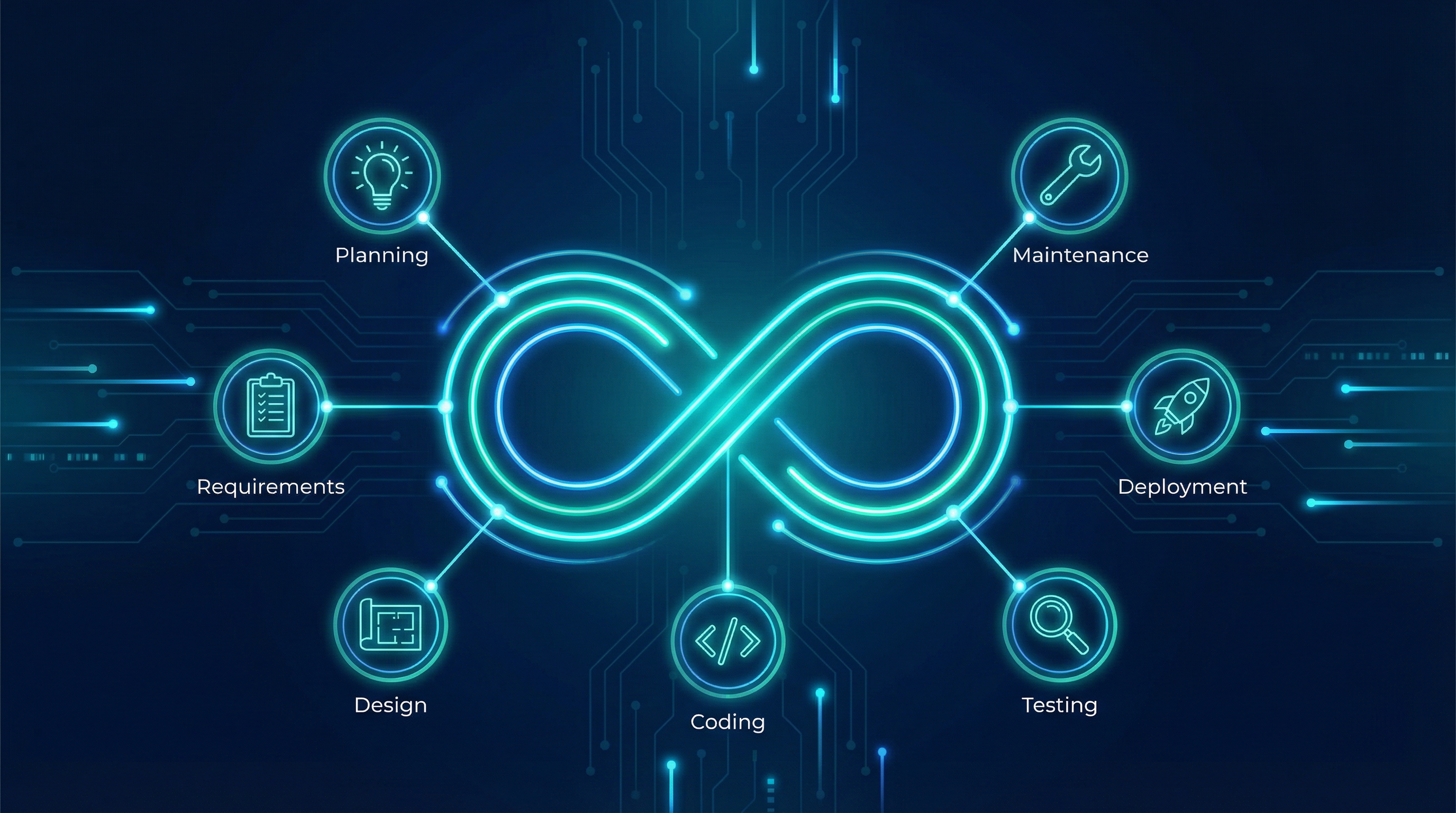
Building software without a structured plan is like constructing a skyscraper without a blueprint—it might stand for a while, but eventually, it will collapse under its own weight. In the fast-paced world of software engineering, delivering high-quality products on time and within budget requires a systematic approach.
Enter the Software Development Life Cycle (SDLC). The SDLC is a structured framework used by engineering teams to design, develop, test, and deploy high-quality software. It provides a clear roadmap that transforms a conceptual idea into a fully functional, maintainable product. Whether you are building a simple web application or a complex enterprise system, adhering to the SDLC ensures visibility, quality control, and risk management throughout the project.
In this comprehensive guide, we will break down the seven essential phases of the SDLC, explore the most popular methodologies, and discuss how practices like DevSecOps are reshaping the way we build software.
Planning & Requirement Analysis
The foundation of any successful software project is laid before a single line of code is written. The planning phase is where stakeholders, project managers, and senior engineers collaborate to define the project's scope, purpose, and feasibility.
During this stage, the team asks critical questions: What problem are we solving? Who are the end-users? What are the technical and financial constraints?
A comprehensive feasibility study is conducted to evaluate operational, technical, and economic viability. This ensures that the organization has the necessary resources and technology to complete the project successfully.
Key Deliverables
Timelines, resource allocation, milestones, and project scheduling.
Technical, operational, and economic viability assessment.
Key Players
Project Managers, Stakeholders, and Senior Engineers drive this phase, ensuring alignment between business objectives and technical capabilities.
Defining Requirements
Once the project is deemed feasible, the next step is to clearly define and document the specific requirements of the software. This phase bridges the gap between business needs and technical execution.
Business Analysts and Product Owners work closely with clients and end-users to gather both functional requirements (what the system should do) and non-functional requirements (performance, security, and usability standards).
The Software Requirement Specification (SRS)
The culmination of this phase is the creation of the SRS document. The SRS acts as the definitive “Bible” for the development team, outlining every feature, behavior, and constraint of the final product. A well-crafted SRS prevents scope creep and ensures that all stakeholders share a unified vision of the end goal.
SRS Document Typically Includes:
- Functional requirements — features, behaviors, and use cases
- Non-functional requirements — performance, security, scalability
- System constraints — hardware, platform, and integration limits
- Acceptance criteria — conditions for sign-off
System Design & Architecture
With the requirements clearly defined, system architects and lead developers begin translating the SRS into a technical blueprint. The design phase establishes the overall architecture of the software, dictating how different components will interact.
Two Levels of Design
High-Level Design (HLD)
Focuses on the overarching system architecture, database design, and the relationships between major modules.
Low-Level Design (LLD)
Dives into granular details, defining the logic of individual components, API interfaces, and specific database tables.
Key Deliverables
Deliverables include data flow diagrams, entity-relationship diagrams, and user interface mockups. The resulting Software Design Document (SDD) provides developers with the exact specifications needed to begin coding, ensuring that the architecture is scalable, secure, and aligned with the project's goals.
Development & Coding
The development phase is where the conceptual design is finally transformed into tangible, executable software. This is typically the longest phase of the SDLC, requiring deep focus and collaboration among frontend, backend, and full-stack developers.
Guided by the Software Design Document, engineers write code using appropriate programming languages and core language features. Adherence to coding standards and best practices is paramount during this stage.
“The emphasis should always be on utilizing core language features securely and efficiently, rather than over-relying on external frameworks that introduce unnecessary dependencies.”
Best Practices During Development
- Code Reviews: Regular peer reviews maintain high code quality and catch issues early.
- Static Code Analysis: Automated tools scan for vulnerabilities and code smells.
- Version Control: All code is managed through Git with clear branching strategies.
- Unit Testing: Preliminary tests ensure individual functions operate correctly before integration.
Testing & Quality Assurance
Once the code is written, it must be rigorously evaluated to ensure it meets the standards defined in the SRS. The testing phase is a critical quality inspection designed to uncover bugs, vulnerabilities, and performance bottlenecks before the software reaches the end-user.
Testing Methodologies
Unit Testing
Verifying individual components in isolation.
Integration Testing
Ensuring different modules communicate flawlessly.
System Testing
Evaluating the complete, integrated application.
User Acceptance Testing
Validating the software meets business needs.
Any defects discovered are documented in detailed bug reports and sent back to the development team for resolution. This iterative cycle of testing and fixing continues until the software is deemed stable and ready for release.
Deployment
The deployment phase marks the transition of the software from the development environment to the live production environment, making it accessible to end-users.
In modern development workflows, deployment is rarely a manual process. Instead, it relies heavily on Continuous Integration and Continuous Deployment (CI/CD) pipelines to automate the release.
Deployment Strategies
Canary
Release to a small subset of users first to detect issues early.
Blue-Green
Run two identical environments to minimize downtime during switch.
Rollback
Ensure instant revert capability in case of critical production issues.
The primary deliverable of this phase is the live, functioning application. However, the team must also ensure that rollback strategies are in place in case unexpected critical issues arise in the production environment.
Maintenance & Evolution
The software development life cycle does not end once the product is launched. In fact, the maintenance phase is often the longest and most resource-intensive part of a software's lifespan.
Types of Maintenance
Corrective
Fixing bugs and resolving production issues discovered by users or monitoring systems.
Adaptive
Updating the software to work in changing environments (new OS, hardware, or regulations).
Perfective
Enhancing performance and adding new features based on user feedback and market demands.
Continuous monitoring and regular updates ensure that the software remains secure, relevant, and valuable over time.
Choosing the Right SDLC Model
There is no one-size-fits-all approach to software development. Different projects require different methodologies based on their complexity, timeline, and flexibility requirements.
| Feature | Waterfall | Agile | DevOps | V-Model |
|---|---|---|---|---|
| Flexibility | Low | High | Very High | Low |
| User Feedback | At the end | Continuous | Continuous | At the end |
| Cost of Change | High | Low | Low | High |
| Speed | Slow | Fast | Very Fast | Slow |
| Best Use Case | Fixed Requirements | Evolving Requirements | Continuous Updates | Critical Safety Systems |
While Waterfall provides a rigid, linear structure ideal for highly predictable projects, Agile and DevOps have become the industry standards, offering the flexibility needed to adapt to rapidly changing market demands.
The Future: DevSecOps & Shift-Left
Historically, security was treated as an afterthought—a final checkpoint during the testing phase just before deployment. This approach often led to delayed releases and costly architectural rewrites when fundamental security flaws were discovered late in the cycle.
Today, the paradigm has shifted toward DevSecOps, which integrates security practices into every single phase of the SDLC.
The Shift-Left Principle
Moving security considerations as early in the development process as possible. Instead of waiting for Phase 5 to run security scans:
Threat Modeling is conducted during the Design phase (Phase 3).
SAST (Static Application Security Testing) is integrated into the developer's coding environment (Phase 4).
Security is a shared responsibility across the entire team, not just the security department.
By making security a shared responsibility across the entire team, organizations can build robust, resilient software without sacrificing speed or agility.
Build Better Software
The SDLC is not just a process—it is the backbone of every successful software project. By mastering these seven phases and choosing the right methodology, your team can deliver high-quality, secure, and maintainable software consistently.
Explore SDLC Resources